

Climate change risks
Climate change refers to long-term variations in temperature and weather patterns. Although the climate has always evolved naturally, the term climate change refers to the phenomenon of accelerated warming caused by human activities since the beginning of the industrial era.
The impacts of climate change are numerous. There are 2 types of risk for all economic players:
- physical risks linked to exposure to the physical consequences of climate change, including chronic physical risks (rising temperatures and heat waves, water scarcity, desertification, melting ice and rising sea levels) and acute physical risks (more frequent extreme weather phenomena such as droughts, floods, storms, fires, etc.).
- transition risks induced by the transition to a low-carbon economy (regulatory changes, mitigation policies, market developments, etc.).
Climate change has repercussions at every level

on transport infrastructures
on transport infrastructures

on companies and organizations
on companies and organizations

on insurance companies
on insurance companies

on healthcare facilities
on healthcare facilities

on agriculture
on agriculture

on biodiversity
on biodiversity

on human health
on human health

on populations
on populations
Climate resilience: now an unavoidable challenge for companies and organizations
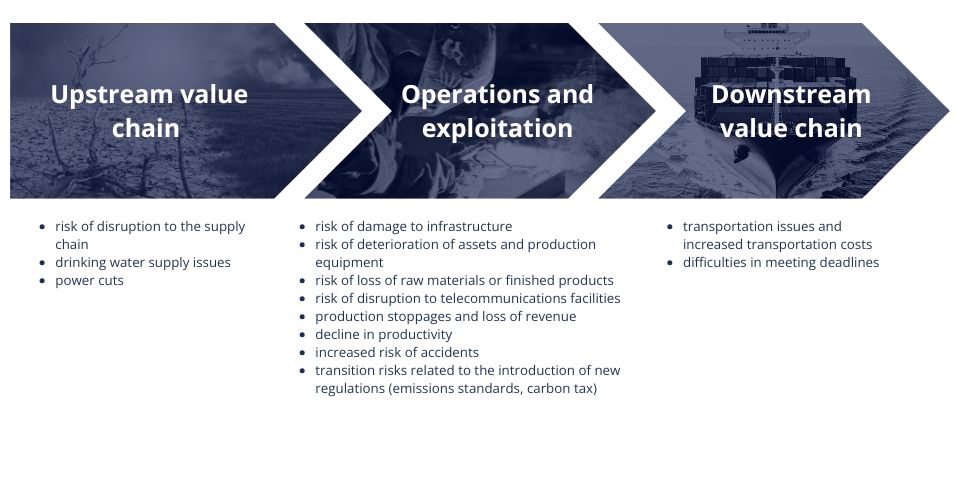
Clearly, climate change is likely to have a major impact on business continuity.
Investing in climate resilience and implementing an adaptation strategy is becoming a must for companies!
As with all cross-functional issues, climate resilience needs to involve a wide range of corporate functions: strategic management, industrial management, sustainable development management, safety management, etc.
In addition to being an environmental issue, climate change can also be seen as an opportunity for companies to rethink their business model in order to adapt and operate sustainably in the years ahead.
Apave at your side
Apave can help you assess the risks and opportunities associated with climate change, and build your adaptation strategy.
Our services range from vulnerability analysis to the definition of a climate change adaptation plan:

evaluation of future scenarios
Assessment of the impacts and opportunities of climate drift on the company or organization concerned (including its own sites and value chain) according to several scenarios.

resilience analysis
Assessment of the climatic vulnerability of sites and activities/processes most critical to your business.

definition of a climate change adaptation plan
Identification of actions to be taken to ensure the long-term viability of the company or organization concerned.
Why choose Apave to support you?
We've been working alongside companies for over 20 years on climate and sustainability issues, with a comprehensive offering on climate mitigation, and we're now naturally at your side with a climate adaptation offering.
The multi-disciplinary skills of our teams (experts in climate, energy, construction, natural hazards and organizational resilience) enable us to approach the subject of climate resilience in its entirety, and to provide you with relevant support:
- Our offer to get you started with a simplified climate vulnerability assessment at building level. Using R4RE's Bat'Adapt tool, we identify risks and vulnerabilities and propose a first draft of adaptive actions to be planned to ensure your building's resilience.
- To take things a step further, we can carry out a climate vulnerability assessment for your company. Similar to a carbon footprint, a company diagnosis (using the OCARA method, Diag BPI, etc.) will enable you to familiarize your teams with the physical and transitional risks associated with climate change, identify the main current and future risks that could affect your company's activities (on your sites and within your value chain), and draw up a coherent adaptation strategy.


On the same
theme